
How can we make the next generation of AI both more powerful and more sustainable?
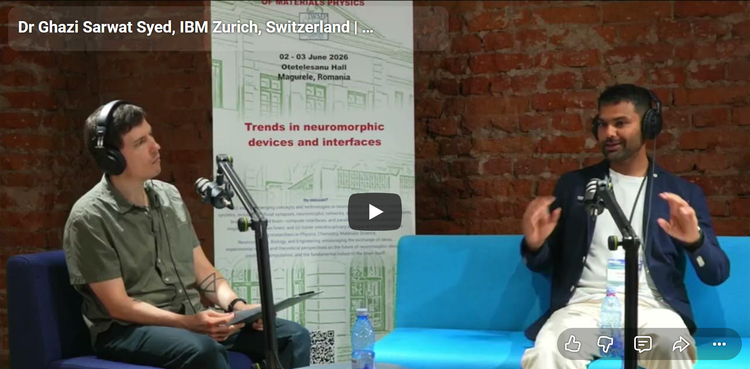
In a recent podcast recorded during the International Workshop of Materials Physics 2026, Dr Ghazi Sarwat Syed (IBM Research Zurich), discussed how emerging computing paradigms can complement today's digital hardware by exploiting the intrinsic properties of physical systems. These approaches aim to accelerate specific computational tasks while significantly improving energy efficiency.
The interview also explores how quantum-inspired computing can contribute to more sustainable and efficient computing, a question that lies at the heart of our work in NEQIOS. By physically emulating key quantum computational principles in classical hardware, we are developing new computing architectures capable of efficiently addressing challenging optimisation problems, without requiring fragile quantum states or cryogenic infrastructure. These approaches offer a practical path towards sustainable, high-performance computing while complementing the continued development of quantum technologies.
Ultimately, one of the key messages of the interview is that the future of computing is unlikely to be defined by a single technology. This clsoely aligins with the NEQIOS vision, in which heterogeneous systems combine analogue in-memory computing, integrated photonics and reconfigurable nonlinear computing.
Beyond the technology, Ghazi also reflects on the importance of people. Scientific breakthroughs begin with curiosity, are driven by collaboration and perseverance, and flourish through mentoring the next generation of researchers. As we shape the future of computing, investing in talent is just as important as advancing technology.
Watch the full interview here: Dr Ghazi Sarwat Syed, IBM Zurich, Switzerland | IWMP2026 Talks
